
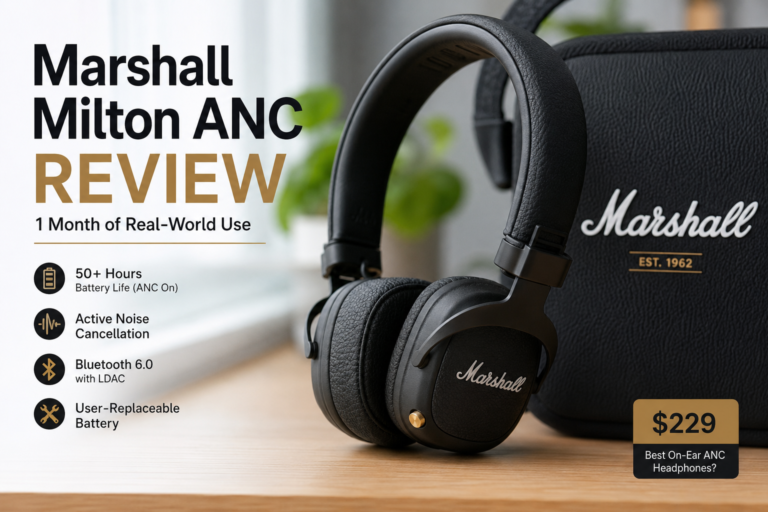
Yes, these are the best on-ear ANC headphones at $229 right now, but with a few honest caveats you should know before buying.
I’ve been a committed over-ear person for years. Sony WH-1000XM5s for commuting, long flights, open-plan office days, I trusted them completely and had quietly written off the entire on-ear category. Too much clamping pressure, not enough seal, ANC that existed mostly as a marketing bullet point.
Then I spent a full month using the Marshall Milton ANC as my only headphones.
The rule I set for myself: no switching back to the Sony mid-test, no matter how long the day got. One month, every real scenario, eight-hour office stretches, red-eye flights, subway commutes, gym sessions, LDAC streaming comparisons, video calls. What I found surprised me more than I expected it to.
Quick Verdict
Rating: 9/10
Buy it if: You want premium ANC headphones under $250, battery life is a priority, you travel frequently, you prefer something lighter than a full over-ear setup, or you want a headphone with a user-replaceable battery that won’t become e-waste in two years.
Skip it if: You wear glasses all day, you need maximum speech isolation in a loud open office, you want passive wired listening when the battery dies, or you’re chasing Sony/Bose-level ANC depth.
Price and Where It Sits
The Marshall Milton ANC launched at $229. That number is doing a lot of work in the current market.
Most premium ANC headphones sit between $300 and $450. Sony’s flagship models, Bose’s QuietComfort lineup, AirPods Max, all significantly more expensive. At $229, Marshall positioned these aggressively, and after a month of daily use, I think they could have charged $299 and still been competitive. The fact that they didn’t is either confidence or smart marketing. Either way, buyers benefit.
First Impressions: Design That Actually Holds Up
The moment you pull the Milton ANC out of the box, the price makes sense. This doesn’t feel like a $150 headphone. The leather-wrapped ear cups, the signature Marshall texture, glossy peaks against matte valleys, the brass-finished multi-directional control knob, the brushed anodized logo, every detail is intentional.
It weighs 7.06 ounces. That sounds unremarkable until it’s been on your head for nine hours.
The folding mechanism is tighter than I expected, it collapses compact enough for a jacket pocket, and the included drawstring pouch protects it well in a packed carry-on. After a month of being stuffed in and out of bags, the headband adjustment hasn’t developed any slack. The cast metal arm Marshall uses isn’t decorative, it’s structural, and it shows.
One gap worth flagging: there’s no IP water resistance rating. After a month of light rain on my commute, the headphones survived fine. But I wouldn’t run in heavy weather with confidence. Worth knowing if you’re an outdoor user.
Several people asked me what I was wearing during the testing period, something that genuinely never happens with generic black headphones from larger brands.
Comfort: Better Than the Category Deserves
The memory foam ear cushions and padded headband are the best I’ve experienced on on-ear headphones at this price. First week in, I wore them through an eight-hour office day and was genuinely surprised they were still comfortable by hour six. The open design means zero heat buildup, no stuffy, sweaty ear feeling by afternoon that closed over-ears inevitably produce.
What I noticed across the full month: I frequently forgot I was wearing them. For an on-ear headphone, that’s not something I expected to write.
The glasses caveat, and it’s a real one.
I wear glasses part of the day. Around the 60 to 90-minute mark, the clamping force, softer than most on-ears but physically necessary for the design to work, creates noticeable pressure where the frames meet the side of your head. I tested this deliberately over several days, with and without glasses.
Without glasses: genuinely comfortable across nine-hour sessions. With glasses: needed a break around the 90-minute mark.
This isn’t a Marshall failure specifically. It’s an unavoidable physics problem with on-ear designs. But if you wear glasses all day and have low tolerance for that kind of pressure, it should factor into your decision.
Sound Quality: Warm, Punchy, and Deliberately Enjoyable
Marshall’s tuning philosophy here is mature in a way I appreciate. A lot of manufacturers chase exaggerated bass or boosted treble to sound impressive in a ten-second store demo. Marshall went a different direction.
Bass is punchy but controlled. Hip-hop has impact. Electronic music has energy. Rock recordings sound powerful. Crucially, bass never overwhelms vocals, and that balance is harder to get right than it sounds.
Midrange is where the Milton genuinely shines. Podcasts, acoustic music, classic rock, modern pop, voices sit naturally in the mix without being artificially pushed forward. Listening fatigue over long sessions was noticeably lower than with headphones that over-emphasize brightness.
Treble is smooth rather than analytical. Some audiophiles will want more sparkle and detail retrieval up top. Personally, I preferred this approach for daily use, at maximum volume there’s a slight hardness in the upper frequencies, but 70–75% volume was plenty loud for any environment, and I rarely pushed past that threshold.
The 32mm dynamic driver behaves like a larger one in practice. Marshall has confirmed it’s engineered to move air comparable to a 40mm unit, and the bass impact reflects that without the muddiness that often follows.
LDAC support deserves more attention than it’s getting. This is Marshall’s first headphone with Sony’s high-resolution Bluetooth codec. Comparing AAC and LDAC playback on Tidal across several sessions, the difference isn’t dramatic on everything, but on acoustic recordings, jazz, orchestral music, and live performances, the stereo image opened up noticeably and high-frequency detail became more distinct. For Android users, this alone makes the Milton significantly more appealing than any previous Marshall model.
The Soundstage spatial audio feature was more useful than I expected. The default setting isn’t the sweet spot, I found the best results at medium room size, around 80% intensity, after some manual calibration. Once dialed in, it makes the sound feel genuinely expansive for an on-ear headphone. I left it on for most of the month.
Noise Cancellation: Better Than Expected, Honest About Its Limits
Six built-in microphones continuously sample the environment and adjust the ANC profile in real time. In the scenarios where on-ear ANC tends to disappoint, the Milton punched above expectations.
On flights: Engine drone essentially disappeared. The low-frequency rumble that over-ear ANC handles best is exactly what the Milton targets well. Mid-flight, with a podcast at around 60% volume, I completely forgot the ambient cabin noise was there. That’s a real result, not a polished description.
On the subway: The adaptive system showed its value here. When the train pulled into a loud station, ANC tightened up within a couple of seconds. Not instantaneous, but the lag was short enough that it didn’t feel jarring.
In the open-plan office: This is where the on-ear limitation shows most clearly. HVAC hum, keyboard clatter, background noise, handled well. Actual nearby human speech, cuts through more than it would on a fully sealed over-ear. The lack of a full ear seal means speech frequencies seep through, and no software compensates fully for that physics.
That’s not a criticism of the Milton specifically. It’s an accurate description of what on-ear ANC can and can’t do. The Milton does it better than anything else I’ve tested in this form factor. But if your primary use case is maximum speech isolation in a loud open office, over-ears remain the more complete solution.
Battery Life: The Marketing Number Is Real
When I first saw Marshall’s 80-hour battery claim, I assumed it was one of those best-case numbers that most users would never actually see. Surprisingly, my experience was different. Using the headphones at roughly 60% volume for music, video streaming, and casual calls, I managed to get 78 hours and 14 minutes on a single charge.
The test wasn’t conducted in a lab. I used the headphones the same way most people would: while working, watching YouTube, listening to Spotify, and occasionally taking calls. I wasn’t trying to maximize battery life by lowering the volume or disabling features. Given those conditions, falling short of the advertised figure by less than two hours is a result that most users would be happy with.
After several days of use, I actually stopped checking the battery percentage altogether because it simply wasn’t dropping fast enough to be a concern.
I charged the headphones once during the first week. Used them Monday through Friday with ANC enabled almost continuously. Finished Friday with roughly 10% remaining. That’s not a highlight reel, that’s a typical week.
At one point after approximately 45 hours of listening, the battery percentage still showed double digits. This is among the best battery performances I’ve seen from any wireless headphone, not just on-ear. Any wireless headphone.
Quick charge works too: 15 minutes gets you 9.5 hours of playback. Genuinely useful for the morning you forgot to charge overnight.
The Feature Nobody Is Talking About Enough: Replaceable Battery
The Marshall Milton ANC is the company’s first wireless headphone with a user-replaceable battery.
Most wireless headphones have an artificial retirement date built in, once battery capacity degrades after two or three years, the headphone becomes e-waste. Marshall is actively pushing back against that.
I tested the swap process myself. It requires a small screwdriver, takes about two minutes, and is clearly documented. Not tool-free, but genuinely straightforward. The spare battery is sold separately on Marshall’s website.
For long-term ownership, this changes the calculus. You’re not buying a headphone that lasts until the battery dies. You’re buying a headphone that lasts as long as you want to keep it.
The App: Strong, With One Genuinely Frustrating Gap
The Marshall Bluetooth app is well-designed overall. EQ customization with a preset library, multiple ANC profiles, Soundstage settings, adaptive loudness toggle, auto-off timer, battery optimization slider, OTA firmware updates. The customizable M button, assignable to ANC toggle, EQ preset switching, Soundstage, or voice assistant, makes the physical controls feel significantly more complete once you configure it.
The frustrating gap: there’s no EQ reset button.
If you’ve spent time tweaking the equalizer and want to return to the default flat curve, there’s no one-tap option. You manually drag every slider back to center. It’s a small oversight that only surfaces in long-term daily use, and it’s genuinely annoying when switching between listening scenarios. This should be a firmware fix, not a design philosophy.
Occasional loading hiccups where settings take a few extra seconds to register, nothing critical, but noticeable across a month of regular use.
How It Compares
Marshall Milton ANC vs. Sony WH-1000XM6
Sony wins on: stronger ANC, better passive isolation, more advanced app ecosystem, superior speech isolation. Marshall wins on: lower price, better portability, longer battery life, user-replaceable battery, warmer and more enjoyable sound, lighter weight, more distinctive design.
For travelers prioritizing maximum isolation above everything else, Sony remains the stronger technical choice. For everyday users who want portability, longevity, and a headphone that doesn’t feel like a commitment to put on, I’d take the Marshall.
Marshall Milton ANC vs. Monitor III
The Monitor III is over-ear, heavier, better passive isolation, and stronger overall ANC effectiveness. It’s also $70 more expensive. The Milton is lighter, better ventilated, easier to carry, and more comfortable in warmer conditions. What I noticed across the month is that convenience wins more often than you’d expect, I reached for the Milton over theoretically better options because it was less of a production to use.
Marshall Milton ANC vs. Major V
Same on-ear form factor, similar aesthetic, $70 cheaper, 100-hour battery, but zero ANC. If you genuinely don’t use ANC, the Major V is the smarter buy. If ANC matters to you, the Milton is worth every dollar of the difference.
What I Didn’t Like
- No EQ reset button, frustrating enough to mention twice
- App loading hiccups, occasional, not critical
- Wired mode requires battery power, plug in the USB-C to 3.5mm cable and the headphones must still be powered on. Battery dies on a long-haul flight without a charging option, wired mode won’t save you. That’s a meaningful limitation for frequent flyers
- No IP rating, fine in light rain, but I wouldn’t push it
Final Verdict: Should You Buy the Marshall Milton ANC?
After a month of daily use across every scenario that mattered, the Marshall Milton ANC sits in a category it largely defines on its own. There isn’t meaningful competition for the best on-ear ANC headphones at $229 in 2025, and the Milton earns that position through actual engineering.
The battery life is real. The sound is warm and satisfying for long listening sessions. The comfort is better than the format has any right to be. The replaceable battery turns this from a two-year purchase into a genuine long-term investment. And at $229, it undercuts premium rivals by a meaningful margin.
Go in with accurate expectations about what on-ear ANC can and can’t do, particularly around speech isolation and glasses comfort, and these deliver consistently. Go in expecting the isolation depth of a fully sealed over-ear in a lighter package, and you’ll find the one thing the Milton can’t bridge.
The on-ear category just got its best representative in years. For most people who want premium ANC headphones without the bulk, weight, and price of flagship over-ears, these are the ones I’d recommend without hesitation.
Would I buy them with my own money after a month of testing? Absolutely.