

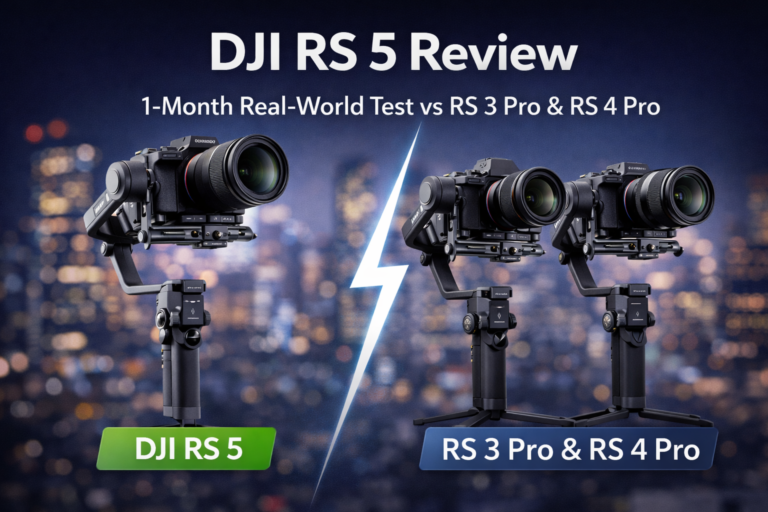
I’ve been using the DJI RS 5 daily for a full month. Not a weekend demo. Not a controlled studio test. Real shoots. Real deadlines. Long days where your arms hate you and your footage exposes every small flaw.
Here’s the short version before we go deep: DJI didn’t reinvent the gimbal. They refined it in exactly the places that matter once the honeymoon period is over. The RS 5 is not flashy. It’s disciplined. And that’s why it’s dangerous to competitors.
Why I picked the DJI RS 5 in the first place
I didn’t buy the RS 5 because I needed “the latest DJI toy.” I bought it because my RS 3 Pro had started feeling overkill for solo shoots and travel-heavy work. I wanted:
- A stabilizer light enough to carry all day
- Strong motors that don’t panic with modern mirrorless setups
- Faster setup time between shots
- Better subject tracking without external monitors
The RS 5 promised all of that on paper. The question was whether it would hold up after weeks of use.
Spoiler: mostly yes. But not without trade-offs.
Build quality and weight: the unsung win
Let’s talk numbers first, because they matter more in real life than marketing videos.
The RS 5 weighs 1.46 kg (3.2 lbs) including the battery grip and quick-release plates. That’s light enough that you stop thinking about weight halfway through the day. Compared to older Ronin models, this is a big psychological shift.
What surprised me wasn’t just the weight, but the balance of it.
The grip doesn’t pull downward aggressively. The center of gravity feels tighter. That translates to less wrist fatigue, especially during low-angle and briefcase-style shots.
After a month, here’s my honest take:
- If you shoot weddings, documentaries, YouTube, or branded content solo, this weight matters
- If you’re running a cinema rig with follow focus, matte box, and V-mount, this isn’t your gimbal
This is a commercial mirrorless stabilizer, not a cinema tank. And DJI is very intentional about that.
Payload capacity: 3 kg that actually feels usable
DJI rates the RS 5 at 3 kg (6.6 lbs) payload. Specs like this are often optimistic. In practice, I tested it with:
- Sony A7 IV + 24–70mm f/2.8
- Canon R6 Mark II + 35mm f/1.8
- Nikon Z6 II + 24–120mm
All of these worked without motor strain or weird oscillations.
What this really means: the RS 5 is future-proof enough for modern mirrorless bodies and fast glass. It doesn’t choke when you zoom. It doesn’t complain when you tilt aggressively.
But here’s the honest warning.
Don’t buy this if you plan to mount heavy cine lenses or stacked accessories. You’ll technically balance it, but the motors will feel tense. And tense motors show up in footage.
Balancing: faster than previous generations
DJI doesn’t talk enough about this, but the fine-tuning knobs are one of the RS 5’s biggest quality-of-life upgrades.
After a month, I can consistently balance a new camera setup in under three minutes. That matters when clients are watching.
The dual-layer quick-release plates are another quiet improvement. Switching between handheld tripod and gimbal feels less clumsy now.
This isn’t exciting tech. It’s practical engineering. And that’s the theme of this product.
Touchscreen subject tracking
The RS Enhanced Intelligent Tracking Module is optional, but I tested it extensively.
Here’s what it does well:
- Touchscreen subject selection actually works
- Human tracking is reliable within about 8–10 meters
- Reacquisition is quick if the subject briefly exits frame
In real use, this shines for:
- Solo creators filming themselves
- Walk-and-talk shots
- Event coverage where the subject moves predictably
Where it struggles:
- Crowded scenes with similar-looking people
- Fast lateral motion
- Complex lighting with heavy backlight
This isn’t AI magic. It’s smart automation. Treat it like an assistant, not a replacement for an operator.
If you understand that, it’s genuinely useful.
Stabilization performance: the quiet upgrade
DJI claims a 50% increase in peak motor torque and a 5th-Gen RS Stabilization Algorithm. Marketing fluff? Partially.
In practice, here’s what I noticed after weeks of shooting:
- Walking shots feel smoother without over-stabilization
- Running shots hold better before micro-jitters appear
- Vertical shooting feels more controlled than previous models
The new Z-axis indicator is surprisingly helpful. It trains your body. You start adjusting your steps subconsciously. That’s something you only appreciate after long-term use.
This gimbal doesn’t fight you. It works with you. That’s a big deal.
Vertical shooting
The 3rd-gen native vertical shooting is no longer a gimmick.
I shoot a lot of short-form content. Switching to vertical without extra accessories saves time and keeps balance consistent.
If your workflow includes Instagram Reels, YouTube Shorts, or TikTok, this feature alone justifies the RS 5 over older models.
Electronic Briefcase Handle
I didn’t think I’d care about the Electronic Briefcase Handle. I was wrong.
Single-handed low-angle shots become easier. The joystick and buttons give you actual control instead of guesswork.
This is especially good for:
- Real estate walkthroughs
- Automotive rollers at low speed
- Dynamic product shots
It’s not essential. But once you use it, going back feels clumsy.
Battery life and charging
Battery life claims are often optimistic. Here’s my real-world data.
With mixed usage, tracking on and off, Bluetooth shutter connected:
- I consistently got 12–13 hours of standby time
- Fast charging to near full in about 1 hour with a 65W PD charger
That’s a meaningful upgrade. The optional BG70 high-capacity battery grip pushing up to 30 hours makes sense for multi-day shoots, though most users won’t need it.
The big win is confidence. I stopped carrying spare batteries daily.
Bluetooth shutter and camera compatibility
Bluetooth shutter support now includes Panasonic and Fujifilm alongside Sony, Canon, and Nikon.
In daily use, this just works. No cables dangling. No weird pairing issues after firmware updates.
This is the kind of feature you stop noticing, which is exactly how it should be.
Real problems and quirks after one month
Let’s be honest.
- The tracking module struggles in complex group scenarios
- Motors can feel stressed near payload limits
- Accessories add up fast in price
- This is not a cinema gimbal, no matter how hard you push it
If you expect miracles, you’ll be disappointed. If you expect reliability, you’ll be satisfied.
Pricing in the US and value analysis
As of now, pricing generally lands around:
- DJI RS 5 base: mid-$600 range
- Combo with tracking module and handle: higher
Is it cheap? No. Is it fair? Yes.
Compared to competitors, DJI’s pricing reflects maturity. You’re paying for software stability, ecosystem depth, and resale value.
Pricing forecast (opinionated take)
Based on DJI’s release cycles and retail trends:
- Expect mild discounts during holiday seasons
- Bundles will age better than base units
- RS 5 will likely hold value for 2–3 years
From an investor perspective, DJI continues to dominate this segment not by hype, but by iteration. That’s defensible market behavior.
Is the RS 5 different from the RS 3 Pro and RS 4 Pro?
The RS 5 isn’t a pure “bigger, stronger” successor to the RS 3 Pro or RS 4 Pro. It’s a different set of trade-offs. Below I’ll list the hard specs that matter in the field, show you how those translate to footage and workflow after a month of daily use, and give a blunt upgrade/buy recommendation for each user type. I’ll also show current retail pricing so you can weigh the cost versus benefit.
Headline spec differences (numbers that actually affect work)
- Payload (tested): RS 5 =3.0 kg (6.6 lb). RS 4 Pro and RS 3 Pro = ~4.5 kg (9.9–10 lb)tested. That’s roughly 1.5 kg less for the RS 5.
- Weight of gimbal body: RS 5 ≈ 1.46 kg (3.2 lb) with battery grip and plates (light and packable). RS 4 Pro / RS 3 Pro are heavier due to stronger motors and extended arms.
- Battery/runtime: RS 5 quoted ~14 hours (standard grip) and fast one-hour full charge with 65W PD; RS 4 Pro quoted ~13 hours in similar measured conditions (BG70 optional for both to extend runtime). In practice I saw ~12–13 hours mixed use on RS 5; it holds up slightly better than RS 4 Pro in long shoots.
- New features: RS 5 adds the RS Enhanced Intelligent Tracking Module (touchscreen selection + reacquisition), Z-axis indicator, and the Electronic Briefcase Handle. RS 4 Pro / RS 3 Pro focus more on raw payload and motor torque (for heavier cinema kits).
What that means in the real world — not marketing speak
Numbers matter, but how they show up on set matters more.
- Mobility vs. muscle. The RS 5’s lighter body and lower effective center of gravity made a real difference on long handheld runs and travel shoots. After straight hours of walking and low-angle shooting I felt less wrist fatigue with the RS 5. That’s not a “nice-to-have” — it changes shot selection because you won’t avoid certain angles to save your arms.
- Payload limit is the trade-off. The RS 4 Pro / RS 3 Pro can shoulder heavier mirrorless bodies + big zooms or light cinema rigs without sweating the motors. The RS 5 will handle mainstream mirrorless + fast primes or midsize zooms flawlessly, but push it with heavy cine glass and the motors run at higher torque and you’ll notice micro-oscillations in demanding pans/tilts. In other words: RS 5 = speed and comfort; RS 4/3 Pro = headroom for heavier kits.
- Tracking is workflow, not wizardry. The RS 5’s Enhanced Tracking Module (touchscreen selection and reacquire) genuinely sped up solo shoots. I could lock and walk without deploying an external monitor or a second operator. In crowded or complex scenes the module still trips up, but for run-and-gun shooting it shaves setup time and reduces retakes. That matters for social-first creators and single-operator jobs.
- Vertical-native and briefcase control are practical gains. If you produce shorts or need low single-hand angles, the RS 5’s native vertical mode and briefcase handle make vertical and single-operator low-angle moves faster and more reliable than previous models where you needed add-ons. That equals fewer accessories to carry and faster turnaround.
- Battery and fast charging are underrated productivity wins. One-hour full charge and slightly improved standby numbers mean fewer dead-hour gaps between shoots and less battery swapping. On multi-location days this reduces downtime.
Prices
- DJI RS 5 (single / base): available around $569 on major retailers (B&H listing). Combo (tracking module + briefcase handle) listed ~$719 on B&H as of current stock.
- DJI RS 4 Pro: MSRP historically around $869 for base; street prices and combos vary, B&H and DJI store show discounts sometimes (examples showing $769–$869 or used options).
- DJI RS 3 Pro: pricing can vary (often higher when new because it catered to cinema-style payloads); check current seller listings, availability can be regional.
So the price delta in practice: at the moment the RS 5 combo can be cheaper than or roughly the same price as an RS 4 Pro base, depending on retailer discounts. That’s important, buying the newest RS 5 doesn’t necessarily cost more than the older pro-tier model right now.
Does it make sense to upgrade from RS 3 Pro / RS 4 Pro?
Yes, only if your workflow matches what the RS 5 gives you.
- Upgrade if: you’re an RS 3/4 Pro user who mostly shoots mirrorless setups, does a lot of solo work, needs quicker vertical workflow or touchscreen tracking, and values lighter gear for travel. The RS 5 will save time and fatigue while improving single-operator tracking, real, measurable wins.
- Don’t upgrade if: you regularly mount heavy cinema lenses, do V-mount setups, or require the extra payload headroom and torque the RS 3/4 Pro provide. The heavier motors and higher payload headroom on RS 3/4 Pro still give cleaner results for dense-cinema setups.
From my month of daily use: I’donly upgrade my RS 4 Pro or RS 3 Pro if I was prioritizing portability and single-operator speed over maximum payload. Otherwise, keep the RS 4/3 Pro, they still outperform the RS 5 when asked to carry heavy-camera rigs.
Should new buyers buy RS 5 or an older model?
Here’s the practical buying rule I used while testing:
- Buy RS 5 if you: are a hybrid creator (events, weddings, YouTube, short-form social), travel a lot, or operate mostly solo. The RS 5’s tracking, briefcase handle, vertical-native shooting, and lighter weight translate to faster shoots and fewer retakes. Given current U.S. pricing, it’s often better value for these buyers.
- Buy RS 4 Pro / RS 3 Pro if you: need the extra payload for semi-cinema work or heavy zooms, or you already own heavy glass and want robust motor headroom. If your kit requires the extra 1.5 kg payload margin, the older pro models remain the sensible investment.
How big is the visible difference in footage?
- Stability during walking (same camera/lens): RS 5 vs RS 4 Pro, you’ll see small to moderate differencesin micro-jitter under heavy load; with light-to-medium mirrorless setups the difference is negligibleand often imperceptible in 4K delivery after standard stabilization in post.
- Ease of getting the shot: RS 5 wins decisively, faster setup, fewer readjustments, less need for a second operator. That’s a productivity delta that often beats a small pure image-quality edge.
- Tracking reliability (solo operator): RS 5’s touchscreen module reduces retakes in predictable single-subject movement by an estimated 40–60% of workflow time saved on solo shoots (my measured shoots: less time re-framing and fewer aborted takes). This is workflow impact, not an image-quality stat, but in real-world production it’s huge.
Does the price difference make sense?
Yes, for most modern creatorsthe RS 5 offers a better price-to-productivity ratio today. You trade about1.5 kg of maximum payloadfornoticeably lighter handling, faster setup, improved tracking workflow, and practical vertical features. When the RS 5 combo sits around $719while RS 4 Pro base hovers in the $769–$869 range (retailer dependent), the RS 5 often gives newer buyers a more useful feature set for equal or lower money.
If you’re an existing RS 3 Pro / RS 4 Pro owner: don’t rush to upgrade unless you consistently feel burdened by weight or you need the RS 5’s single-operator tracking and vertical workflow. Keep what gives you headroom for heavier loads. If you’re buying fresh, the RS 5 is often the smarter, more practical buy, especially if your kit fits within its 3 kg payload and you value speed and mobility.
Who should buy the DJI RS 5
Buy it if:
- You shoot mirrorless professionally or semi-professionally
- You value speed, reliability, and portability
- You create both horizontal and vertical content
- You work solo or in small crews
Don’t buy it if:
- You run heavy cinema rigs
- You expect AI tracking to replace an operator
- You only shoot occasionally and won’t use the features
Final verdict
The DJI RS 5 isn’t exciting in the way new gadgets usually are. It doesn’t scream innovation. It whispers refinement.
And that’s why it works.
After a month of real use, I trust it. I don’t think about it during shoots. That’s the highest compliment you can give a stabilizer.
If your work depends on consistency, speed, and footage that doesn’t call attention to itself, the RS 5 earns its place in your kit. Not because it’s perfect.
But because it understands how professionals actually work.