

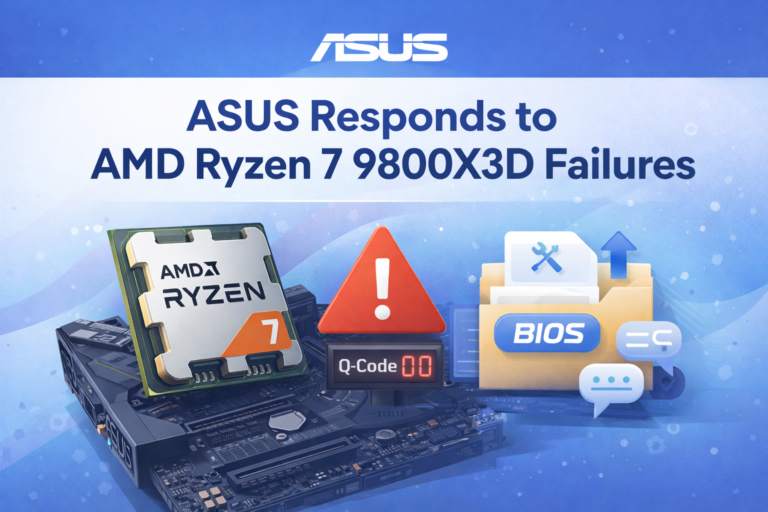
Over the last couple of weeks, something unusual caught the attention of the PC building community. Users running AMD’s flagship gaming chip, the Ryzen 7 9800X3D, began reporting sudden system failures when paired with ASUS 800-series AM5 motherboards. At first, it looked like isolated incidents. Then the pattern became harder to ignore.
Now, ASUS has officially acknowledged the situation and confirmed it has launched an immediate internal review, working closely with AMD to investigate the failures.
This is not a routine BIOS bug. And it’s not something enthusiasts take lightly, especially with another X3D CPU launch right around the corner.
What users are actually experiencing
The most common symptom reported so far is simple but alarming: systems refusing to boot. Multiple users describe motherboards stopping at Q-Code 00, effectively leaving the CPU unusable. In at least one case, the issue surfaced on a premium board, the ROG Crosshair X870E Hero, and similar reports followed on other high-end ASUS X870E models.
What makes this situation different from typical early-platform hiccups is repetition. Several users reported multiple CPU failures across different systems. That’s when concern shifted from “bad luck” to “something systemic.”
Earlier reports of 9800X3D failures were largely associated with non-ASUS boards. The moment ASUS platforms entered the conversation, scrutiny intensified.
ASUS’s official stance so far
ASUS has confirmed that it is running preventive compatibility and performance checks across its AMD 800-series motherboards. The company says it is validating real-world failure reports alongside AMD and aims to deliver timely solutions if a root cause is identified.
For now, ASUS is recommending:
- Updating affected motherboards to the latest BIOS
- Using ASUS EZ Flash or BIOS Flashback for updates
- Contacting ASUS customer support directly if failures have occurred
They’ve also reiterated their commitment to transparency and user trust. That wording matters, because right now, trust is what’s at risk.
My take: why this feels bigger than a normal BIOS issue
Here’s the thing most official statements won’t say outright.
When a system fails to POST, especially at Q-Code 00, it often points to deeper problems than a simple firmware bug. Voltage behavior, memory training, and CPU initialization all happen in a very narrow window during boot. X3D chips are particularly sensitive because of their stacked cache design and tighter thermal and power tolerances.
If this were purely a BIOS timing issue, we’d likely see inconsistent boot behavior, not repeated CPU deaths. The fact that users report permanent failures raises uncomfortable questions about power delivery behavior during early boot or aggressive default tuning on certain boards.
That doesn’t mean ASUS is definitively at fault. It does mean the investigation needs to be fast and very thorough.
Why the timing couldn’t be worse
This statement comes just days before AMD’s upcoming Ryzen 7 9850X3D launch. That matters more than it sounds.
X3D buyers are usually enthusiasts and gamers. They follow Reddit threads. They watch failure reports closely. Even a hint of motherboard-related CPU risk can push buyers to delay upgrades or switch brands entirely.
ASUS knows this. AMD definitely knows this.
If this issue isn’t clarified quickly, it could cast a shadow over an otherwise highly anticipated CPU release.
What users should realistically do right now
If you’re running a Ryzen 7 9800X3D on an ASUS 800-series board and everything is stable, don’t panic. But don’t ignore updates either.
My practical advice:
- Update your BIOS, even if your system feels fine
- Avoid manual overvolting or aggressive memory tuning for now
- If you experience failed boots or instability, stop power-cycling repeatedly. That’s how marginal issues become permanent ones.
- Contact ASUS support early. Document everything.
Repeated forced boots are one of the fastest ways to turn a recoverable issue into dead silicon.
The bigger picture
Hardware failures happen. What defines a manufacturer is how quickly and transparently they respond when patterns emerge.
ASUS acknowledging the issue publicly is the right first step. The next step is data. Clear findings. And if needed, conservative BIOS updates that prioritize CPU safety over marginal performance gains.
Until then, the PC community will be watching closely. And honestly, they should.
This isn’t just about one CPU. It’s about confidence in an entire platform.