

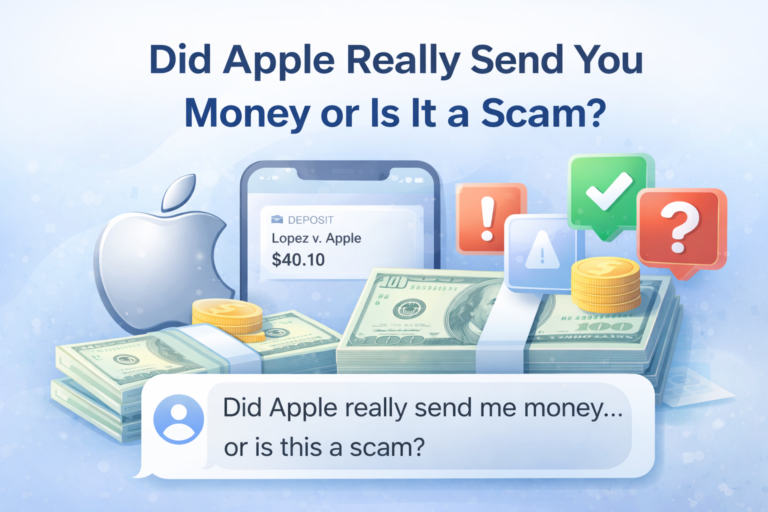
Over the last few days, I’ve had multiple people ask me the same question, usually with a screenshot attached:
“Did Apple really send me money… or is this a scam?”
Short answer: for many people in the US, it’s real. And yes, it’s tied to Siri.
Apple has started issuing payments from a $95 million class-action settlement related to allegations that Siri recorded private conversations without user consent. If you filed a claim on time, you may already have the money or an email waiting for you.
Let’s break down what actually happened, why these payments look confusing, and what you should do next.
What this settlement is really about (without the legal fog)
This case, Lopez v. Apple Inc., goes back to long-standing privacy concerns around Apple Inc.’s voice assistant Siri.
The lawsuit claimed that Siri sometimes activated unintentionally and recorded conversations users believed were private. Not because they said “Hey Siri,” but because:
- Siri misheard similar words
- A button was pressed accidentally
- Or the assistant triggered on its own
Some of those recordings, according to the lawsuit, were later reviewed by contractors and allegedly used in ad-targeting workflows. Apple has consistently denied wrongdoing and says Siri data was only reviewed in limited cases to improve performance.
Important detail most people miss:
Apple did not admit guilt. This is a settlement, not a verdict.
Why people are suddenly getting money now
Apple agreed to the $95 million settlement last year. The claims process closed on July 2, 2025. Payments started going out in late January 2026, with most distributions finishing by January 26.
If you:
- Owned a Siri-enabled Apple device
- Between September 17, 2014 and December 31, 2024
- Experienced an unintended Siri activation during a private conversation
- And submitted a claim on time
Then you’re in the payout pool.
If you didn’t file a claim, there’s no retroactive payment. No appeal. That door is closed.
Why the payment looks strange (and triggers scam alarms)
This is where things get messy.
Some people received:
- Direct deposits labeled “Lopez v. Apple” or “Lopez Voice Assistant”
- Emails with digital checks
- Payments routed through ClearPath Payments
- Funds via PayPal, Venmo, ACH, or paper checks
From a security perspective, I get the confusion. Random settlement emails look exactly like phishing attempts.
Here’s how you tell it’s legitimate:
- You remember filing a claim
- The email references the Siri settlement directly
- No one asks you for passwords or sensitive info
- The payment matches small dollar amounts, not hundreds or thousands
ClearPath Payments isn’t a scam here. They’re a third-party distributor used by the settlement administrator. That intermediary layer is what made this feel sketchy to many users.
How much money are people actually getting?
This part disappoints some folks, so let’s be honest.
The settlement capped payouts at:
- Up to $20 per device
- Maximum of 5 devices
- $100 per person, at most
But that’s the cap, not the guarantee.
Because millions of people filed claims, the real payouts are lower. Early reports show:
- Around $8 per device
- Many people received $30–$45 total
- One verified payment showed $40.10
That’s not life-changing money. But it is real money.
What I think watching this closely
This settlement matters less for the payout and more for the signal it sends.
Voice assistants live in our homes, cars, and pockets. When they misfire, they don’t just record noise. They record context. That’s where privacy becomes personal.
From Apple’s side, this case forced changes:
- Reduced human review of Siri audio
- More transparency around voice data
- Opt-in controls that didn’t exist a decade ago
From a user perspective, it’s a reminder:
If a product is free or deeply embedded, you are part of the data pipeline, even when companies promise restraint.
What you should do right now
If you think you’re eligible:
- Check your email, including spam
- Check your bank and payment apps for unusual deposits
- Look for references to “Lopez,” “Voice Assistant,” or Apple settlement
If you got a payment:
- Accept it within 120 days, or it’s forfeited
- Keep the confirmation for records
If you missed the deadline:
- There’s nothing to file now
- Anyone asking you to “recover” settlement money is lying
Final take
This isn’t about catching Apple in a gotcha moment. It’s about how modern tech quietly blurs the line between convenience and surveillance.
If you got paid, take it. If you didn’t, take the lesson.
Voice assistants are useful. They’re also always listening for something.