

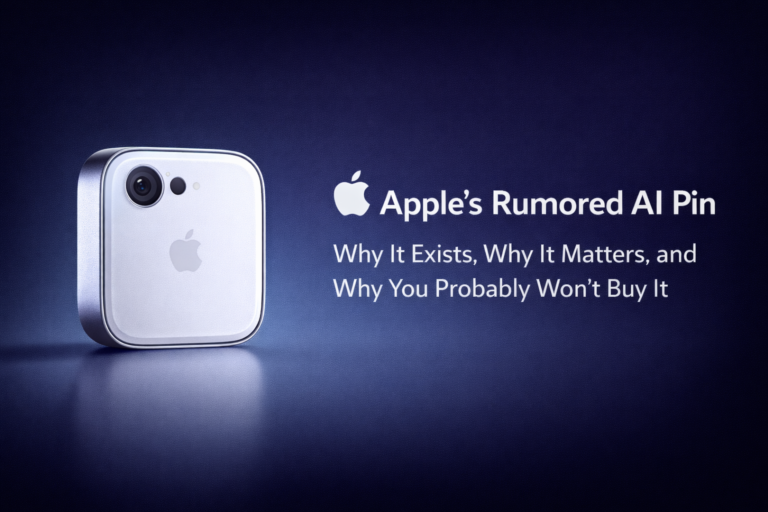
I’m fairly confident the Apple AI pin is real.
I’m equally confident you won’t see it on a shelf anytime soon.
That sounds contradictory, but it isn’t. If you’ve watched Apple long enough, this fits a familiar internal pattern: build something concrete, leak just enough to test reactions, learn quietly, then either absorb the lessons into other products or kill the idea without ceremony.
This pin looks exactly like that kind of project.
Let’s talk about why it exists, where it breaks down, and what actually changes if it succeeds.
Why Apple needs to explore something like an AI pin (even if it never ships)
Apple is late to visible AI. Not “behind the scenes,” not “research papers,” but consumer-facing intelligence that feels modern.
That matters because Apple’s biggest advantage historically hasn’t been raw innovation. It’s been interface control. The iPod wheel. Multi-touch. The Apple Watch crown. Apple doesn’t just adopt new tech, it decides where it lives physically.
Generative AI breaks that pattern.
AI doesn’t naturally belong to a screen. It wants context, voice, vision, and low-friction access. Phones are workable, but not ideal. So Apple has a problem: how do you design an interface for AI that doesn’t feel bolted onto a rectangle of glass?
This is where a pin makes sense, not as a product, but as a probe.
A small, body-worn object lets Apple test things you simply can’t simulate on an iPhone:
- How much ambient audio users tolerate before it feels invasive
- Whether on-device vision is useful without explicit intent
- Latency when intelligence lives half on-device, half on phone
- Battery drain when AI is context-aware instead of event-driven
- Heat limits in always-on form factors
- Human discomfort with passive cameras
None of this requires a launch. It requires real hardware in real environments.
That’s why the leaked details matter.
The hardware leak tells us how Apple is testing, not what it’s selling
The descriptions aren’t conceptual. They’re operational.
An AirTag-sized, aluminum-and-glass device. Dual cameras. Multiple microphones. A speaker. A button. Wireless charging.
That’s not a pitch deck. That’s a working lab unit.
What’s missing is more important than what’s included.
There’s no clear use case.
When Apple is serious about shipping something, leaks usually hint at why it exists. Even early iPhone rumors framed it as a phone, an iPod, and an internet device. Vision Pro leaks emphasized spatial computing.
Here, we have components without a story.
That’s a tell.
It suggests Apple is mapping sensory surfaces, not launching a category.
Why this is almost certainly not Apple’s next consumer device
We’ve already seen what happens when companies try to ship AI-first wearables without a replacement story.
The Humane AI Pin failed not because it was poorly built, but because it lived in an awkward middle ground. It didn’t replace the phone. It didn’t outperform it either. It added friction, cost, and social discomfort without removing anything.
Same story with Rabbit R1. Clever idea. Clear ambition. No compelling reason to carry it once the novelty wore off.
This is the graveyard Apple is very aware of.
A device that:
- Still needs a phone
- Can’t fully replace a phone
- Records by default
- Introduces privacy anxiety
is dead on arrival for mass adoption.
Apple doesn’t win by being early. It wins by arriving when the trade-offs disappear.
Right now, those trade-offs are front and center.
The real limitation isn’t technology. It’s social tolerance.
Technically, Apple could ship this.
They have the silicon. They have on-device AI. They have privacy frameworks. They could lock everything down, process locally, add indicators, and explain it clearly.
That’s not the problem.
The problem is social friction.
An always-worn camera and microphone changes how people behave around you. Meetings, homes, casual conversations all become uncertain spaces. People don’t want to ask, “Is that thing recording?” every time they speak.
Apple’s brand is built on trust and restraint. Shipping a discreet wearable recorder would punch a hole straight through that positioning.
This isn’t like AirPods or Apple Watch, which made behavior more convenient. This would make behavior more cautious.
Apple avoids products that require society to renegotiate norms just to function.
That’s why this pin, as described, doesn’t align with Apple’s release philosophy.
So what happens if this project is successful internally?
Success here doesn’t mean a pin hits stores. It means the data is useful.
If this experiment works, you don’t get a new product. You get better existing ones.
Here’s the realistic cascade:
- Vision processing insights move into future Apple Watch sensors
- Audio intelligence improves Siri across devices
- Context awareness feeds into iOS-level AI behaviors
- Power and heat learnings shape future AirPods
- Long-term, this informs smart glasses when the tech and culture catch up
This is how Apple actually builds categories. Vision Pro didn’t appear overnight. It was the result of years of sensor, display, and interface experiments quietly folding into each other.
The pin feels like one of those raw ingredients.
Could Apple still surprise us?
Apple can absolutely build a better AI wearable than anyone else.
But that’s not enough.
Hardware quality has never been the bottleneck for this category. The bottleneck is replacement value. Until a wearable AI device clearly removes the need for something you already carry, it remains optional. And optional devices struggle.
After Vision Pro, Apple also knows consumers are far more cautious about buying into new categories without immediate, obvious payoff.
An AI pin doesn’t yet pass that test.
My honest verdict
I believe the Apple AI pin exists.
I believe Apple is learning a lot from it.
I do not believe Apple plans to sell it.
This looks like a classic Apple internal exploration: build it, stress it, understand human behavior around it, then extract the value elsewhere.
If an AI pin ever reaches consumers, it won’t look like this, behave like this, or be positioned like this.
And if Apple ever does try to sell one, specs won’t matter.
They’ll need a story so compelling that people stop asking what it records and start asking how they lived without it.
We’re not there yet.