

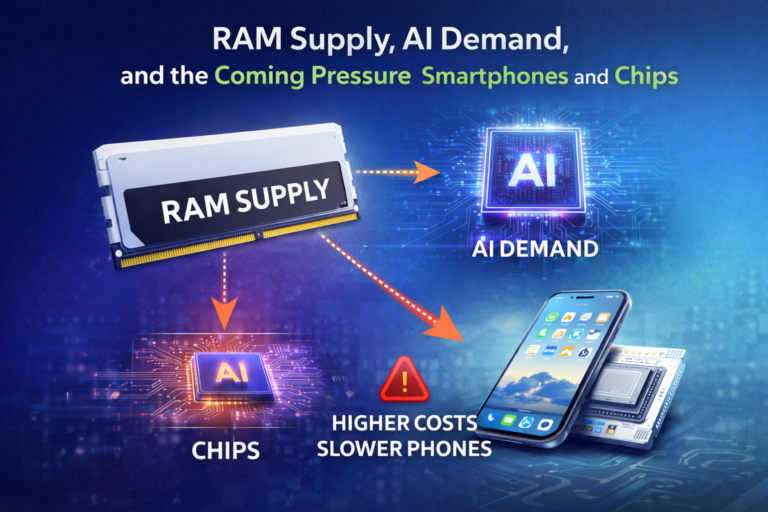
Do you know that AI Is Eating the World’s Memory? or do you know What That Means for Your Phone and wallet? Or why the RAM suddenly matters more than CPUs?
For most of the last two decades, the semiconductor story was simple, faster CPUs, smaller nodes, more cores. If something felt slow, the answer was always “better compute.”
That logic no longer holds.
The AI boom didn’t just change what chips we need. It changed which part of the system breaks first.
Here’s the thing most consumers and even many investors miss:
AI workloads are far more memory-bound than compute-bound.
A modern AI model doesn’t fail because the processor can’t calculate fast enough. It fails because data can’t be fed to the processor quickly, consistently, and in massive parallel streams. That’s a memory problem, not a CPU problem.
GPUs grabbed headlines because they do the math. RAM does the unglamorous work of keeping the math fed.
And now, RAM is quietly becoming the choke point.
The overlooked bottleneck: memory, not compute
In practical terms, RAM determines:
- How large a model can be loaded
- How fast inference happens
- How many AI tasks can run in parallel
- How responsive on-device AI feels
This applies everywhere:
- Data centers running large language models
- Smartphones doing on-device AI
- PCs using AI-assisted workflows
- Cars, cameras, and edge devices
We’ve reached a point where adding more compute doesn’t help if memory bandwidth and capacity don’t scale alongside it.
That’s why RAM matters again. Not as a spec sheet line, but as a system limiter.
Why RAM supply is structurally limited
Unlike CPUs or GPUs, RAM manufacturing has some brutal realities:
- Fewer players
- Higher sensitivity to defects
- Slower scaling
- Lower margins historically
Logic chips can be diversified across many foundries. Memory cannot.
That structural limitation is what turns rising AI demand into real pressure across consumer electronics.
The framing question we should be asking is simple but uncomfortable:
Is AI quietly reshaping the entire consumer electronics market by starving it of memory?
How limited the RAM manufacturing ecosystem really is
People talk about “chip shortages” as if all chips are the same. They are not.
RAM is a different beast.
Why DRAM and LPDDR are harder to scale than logic chips
DRAM cells are incredibly simple on paper. In practice, they are brutally hard to make at scale.
Each generation demands:
- Tighter tolerances
- Higher density
- Lower leakage
- Better yields
Unlike logic chips, where new designs can justify higher prices, RAM is still treated largely as a commodity. That limits how aggressively manufacturers expand capacity.
LPDDR (used in smartphones) is even trickier:
- Extreme power efficiency requirements
- Tight thermal constraints
- Long qualification cycles with OEMs
You don’t just “spin up” more LPDDR production because demand spikes.
Capital intensity and long lead times
A modern memory fab costs tens of billions of dollars.
Even after funding is secured:
- Construction takes years
- Equipment lead times are long
- Yield optimization can take quarters, not weeks
This means RAM supply reacts slowly. Very slowly.
When demand jumps suddenly, prices move long before capacity does.
Yield sensitivity and process complexity
Memory manufacturing lives and dies by yield.
A small defect rate increase can:
- Kill margins
- Reduce usable output
- Force conservative production targets
That’s why RAM makers prioritize stable, high-margin customers when supply tightens.
Why only a few companies dominate RAM
At a global scale, only three companies matter:
- Samsung Electronics
- SK Hynix
- Micron Technology
Together, they control the overwhelming majority of DRAM and LPDDR supply.
This concentration is not accidental. It’s the result of:
- Decades of capital investment
- Deep process IP
- Painful yield learning curves
Once smaller players exited the market years ago, they never came back.
This is why RAM behaves differently from CPUs or GPUs in supply crunches. There is no backup bench.
AI companies buying RAM in bulk: what’s actually happening
This is where the pressure truly begins.
AI workloads are not just compute-hungry. They are memory-hungry in multiple dimensions.
Why AI workloads consume so much memory
AI models need:
- Large parameter storage
- High-speed access
- Parallel memory channels
- Consistent latency
This drives demand for:
- HBM (High Bandwidth Memory) for GPUs
- DDR5 for servers
- LPDDR5X for edge and mobile devices
HBM, in particular, is a RAM product with extreme constraints and very limited supply. It’s also the most profitable memory product right now.
What hyperscalers are doing differently
Large AI players don’t buy memory like consumers or even PC OEMs.
They:
- Lock multi-year supply contracts
- Prepay for capacity
- Prioritize performance bins
- Accept higher pricing for guaranteed allocation
From a manufacturer’s perspective, this is ideal:
- Predictable demand
- Higher margins
- Lower risk
The result is inevitable.
Why consumer-grade products lose out
When supply tightens, RAM makers prioritize:
- AI accelerators and data centers
- Enterprise servers
- High-margin premium devices
- Everyone else
Smartphones, especially mid-range and budget models, sit uncomfortably low on that list.
This doesn’t cause an immediate shortage. It causes subtle degradation:
- Slower spec upgrades
- Higher component costs
- Compromises disguised as “optimization”
Consumers won’t see empty shelves. They’ll see less progress for more money.
And that’s where the real impact begins.
Immediate market impact: pricing, prioritization, and shortages
When people hear “chip shortage,” they imagine empty shelves and panic buying. That’s not how memory shortages usually work.
RAM shortages are quieter. More subtle. And often more damaging in the long run.
Why RAM prices spike unevenly
RAM pricing doesn’t rise in a straight line.
It spikes selectively.
Here’s why:
- Enterprise buyers lock contracts early
- AI customers accept higher prices
- Consumer OEMs negotiate later and lose leverage
The result is a tiered market:
- AI and data center memory sees priority allocation
- Premium consumer products absorb higher costs
- Budget devices get squeezed hardest
This isn’t speculation. It’s how memory cycles have behaved historically.
Enterprise vs consumer: who wins when supply tightens
From a RAM manufacturer’s point of view, the math is simple.
If one AI customer:
- Buys massive volumes
- Commits long-term
- Pays a premium
Why divert that capacity to:
- Price-sensitive smartphones
- Seasonal demand
- Thin margins
So RAM flows toward the highest certainty and profitability.
Consumer electronics don’t disappear. They just get less favorable terms.
Early signs we’re already seeing
Even before full shortages hit, there are clear signals:
- Slower RAM capacity jumps year-over-year
- OEMs emphasizing “efficiency” over raw specs
- Higher launch prices justified by software features
- Extended device refresh cycles
These are not design choices made in isolation. They are responses to supply pressure.
Historical parallels that matter
We’ve seen this before:
- 2017–2018 DRAM price surge
- Pandemic-era memory allocation shifts
- NAND oversupply followed by sudden tightening
Each time, consumer devices didn’t vanish. They quietly became worse value.
The difference now is that AI demand is structural, not cyclical.
That’s what makes this phase more dangerous.
Impact on smartphones: where users will feel it first
If RAM is under pressure, smartphones are the first mass-market product to feel it.
Not laptops. Not servers. Phones.
Why LPDDR supply is critical for phones
Smartphones rely almost entirely on LPDDR memory.
LPDDR:
- Must be power-efficient
- Runs at high speeds
- Has tight thermal limits
- Requires long validation cycles
You can’t just swap suppliers or redesign overnight.
When LPDDR supply tightens, phone makers face hard choices.
Why flagship phones are better insulated
High-end phones from companies like Apple have advantages:
- Long-term supply contracts
- Willingness to pay more per unit
- Tighter hardware-software integration
- Higher margins to absorb cost increases
This is why flagship phones may continue to see healthy RAM specs, at least on paper.
But even here, compromises are creeping in.
The real pressure point: mid-range and budget phones
This is where things get uncomfortable.
Mid-tier and budget Android phones:
- Operate on thin margins
- Compete heavily on spec sheets
- Can’t absorb large cost increases
When RAM prices rise, these devices face three options:
- Reduce RAM capacity
- Raise prices
- Offset with aggressive software optimization
Most choose a mix of all three.
Likely outcomes users will notice
Over the next few cycles, expect:
- Slower RAM upgrades year-over-year
- Same RAM, higher prices
- “AI features” used to justify cost increases
- More reliance on storage-based memory tricks
- Background app limitations framed as “battery optimization”
None of these feel dramatic individually. Together, they change the user experience.
Why budget Android phones are most vulnerable
Budget phones depend heavily on:
- Commodity LPDDR supply
- Predictable pricing
- Volume economics
When those break down, something has to give.
That’s why memory pressure tends to widen the gap between premium and affordable devices, even if raw performance differences don’t look huge on paper.
Ripple effects on processors, NPUs, and SoCs
Chips don’t operate in isolation. They never have.
But AI has made memory bandwidth a hard performance ceiling.
Why RAM bandwidth matters more than raw compute
Modern SoCs can calculate far faster than they can fetch data.
This creates a strange situation:
- Powerful NPUs waiting idle
- AI accelerators throttled by memory access
- Heat and power wasted on stalled execution units
In short, you can’t compute what you can’t load.
Impact on on-device AI features
On-device AI sounds magical until you hit memory limits.
Tasks like:
- Image generation
- Language translation
- Voice processing
- Real-time video analysis
All demand fast, wide memory access.
When RAM is limited:
- Models are smaller
- Features are delayed
- Processing shifts back to the cloud
This is why many “on-device AI” promises arrive slowly or selectively.
How this affects chip designers
Companies like Qualcomm and MediaTek face a balancing act:
- More compute units don’t help without memory
- Higher clocks increase power draw
- Wider memory buses increase cost and heat
The result is conservative designs, not bold leaps.
Thermal and power trade-offs get worse
Memory access consumes power.
As bandwidth demands rise:
- Thermal headroom shrinks
- Sustained performance becomes harder
- Throttling becomes more aggressive
This is why newer chips sometimes feel less “stable” under prolonged loads despite better benchmarks.
Why silicon innovation alone won’t fix this
You can shrink transistors.
You can redesign cores.
You can optimize instruction pipelines.
You cannot cheat memory physics easily.
Until RAM supply, density, and bandwidth scale in tandem, chip innovation hits diminishing returns.
What smartphone and tech companies will do to survive
When a core component becomes scarce, companies don’t panic. They adapt. Quietly.
Most of the changes users will see won’t be marketed as “RAM shortages.” They’ll be framed as innovation.
Software-first survival strategies
The first lever companies pull is software.
Expect more:
- Memory compression techniques
- Aggressive background app killing
- Smarter caching and eviction policies
- AI models that load in fragments instead of fully
From a technical perspective, this is impressive engineering.
From a user perspective, it often feels like apps reload more often.
This is not accidental. It’s memory pressure management.
Tighter hardware–software integration
Companies with full-stack control have an edge.
That’s why Apple is relatively insulated:
- OS-level memory control
- Custom silicon
- Predictable device configurations
- Long-term memory supply contracts
Android OEMs, especially smaller ones, don’t have that luxury.
Selective feature gating
Another quiet tactic: feature segmentation.
Same hardware, different behavior:
- AI features enabled only on higher tiers
- Regional restrictions
- Storage-based virtual RAM limited by SKU
This keeps BOM costs under control while preserving marketing narratives.
Longer device refresh cycles
When components get expensive, refresh cycles stretch.
Instead of yearly leaps:
- Incremental upgrades
- Reused platforms
- Extended support periods
This is already happening, and memory pressure accelerates it.
Strategic memory contracts
Large OEMs increasingly:
- Pre-book memory years in advance
- Accept price volatility for guaranteed supply
- Favor fewer SKUs to simplify allocation
This stabilizes their business. It doesn’t stabilize prices for consumers.
Can new companies enter RAM manufacturing? Realistically?
No, not soon, not easily.
Long answer matters for investors.
The cost barrier is enormous
A cutting-edge memory fab costs tens of billions of dollars.
That’s before:
- Equipment
- Process tuning
- Yield optimization
- Talent acquisition
Even with government subsidies, this is not a startup-friendly space.
IP and process knowledge are hard walls
Memory manufacturing is not just machines. It’s decades of know-how.
Things like:
- Cell architecture tuning
- Leakage control
- Yield learning curves
- Failure pattern recognition
These are learned painfully over time. You can’t buy them off the shelf.
Yield learning takes years
Even if a new player builds a fab, early yields are low.
Low yields mean:
- High costs
- Uncompetitive pricing
- Limited customers
Most companies can’t survive that phase.
Government support helps, but slowly
Countries like China and India are trying to build memory ecosystems.
They face:
- Long timelines
- Export restrictions
- Talent gaps
- Process maturity issues
This is a 10–15 year story, not a 2–3 year fix.
For the foreseeable future, the market remains dominated by:
- Samsung Electronics
- SK Hynix
- Micron Technology
That concentration is the root of persistent pricing power.
What to expect over the next 2–5 years (pricing and product reality)
RAM pricing outlook (data-backed logic)
Based on:
- Capacity expansion timelines
- AI demand growth
- Contract locking behavior
- Historical memory cycles
A realistic outlook looks like this:
- Short term (1–2 years):
Volatile pricing, upward bias, selective shortages - Mid term (3–5 years):
Higher baseline prices than pre-AI era
Less severe crashes during downcycles
RAM will behave less like a commodity and more like a strategic resource.
Differentiated pricing becomes permanent
We are moving toward:
- Premium memory for AI and enterprise
- Constrained supply for consumer devices
- Price gaps that don’t close quickly
This is a structural shift, not a temporary spike.
Smartphones become more efficient, not more powerful
Expect fewer dramatic spec jumps.
Instead:
- Better scheduling
- Smarter memory use
- AI features optimized for constraints
- Performance gains through software
To users, phones may feel “stable” rather than “exciting.”
Why fewer spec jumps don’t mean stagnation
Innovation doesn’t stop. It changes direction.
When memory is scarce:
- Waste becomes unacceptable
- Optimization becomes competitive advantage
- Engineering discipline matters more than brute force
This often leads to better real-world products, even if benchmarks stagnate.
Final takeaway
AI doesn’t run on hype.
It doesn’t run on marketing.
And it doesn’t run on GPUs alone.
AI runs on memory.
As RAM becomes scarcer and more strategically valuable, it’s quietly reshaping the entire technology stack. Chip design priorities are shifting. Smartphone pricing is becoming harder to justify on raw specs alone. Feature rollouts are more selective, more staged, and more constrained. Even investment risk profiles are changing as memory supply starts to matter as much as compute performance.
Smartphones aren’t disappearing. PCs aren’t doomed.
But the era of careless hardware abundance is over.
The next phase of innovation will be defined by restraint rather than excess. Using less memory more efficiently. Moving data more intelligently. Designing systems that respect physical and economic limits instead of trying to brute-force past them.
For consumers, this means fewer headline-grabbing upgrades and more subtle, software-driven improvements that show up in daily use rather than benchmarks.
For investors, it means memory manufacturers are no longer just cyclical suppliers. They are becoming strategic assets in an AI-driven economy.
And for the tech industry as a whole, it points to one clear conclusion:
The future is no longer compute-first.
It’s memory-first.