

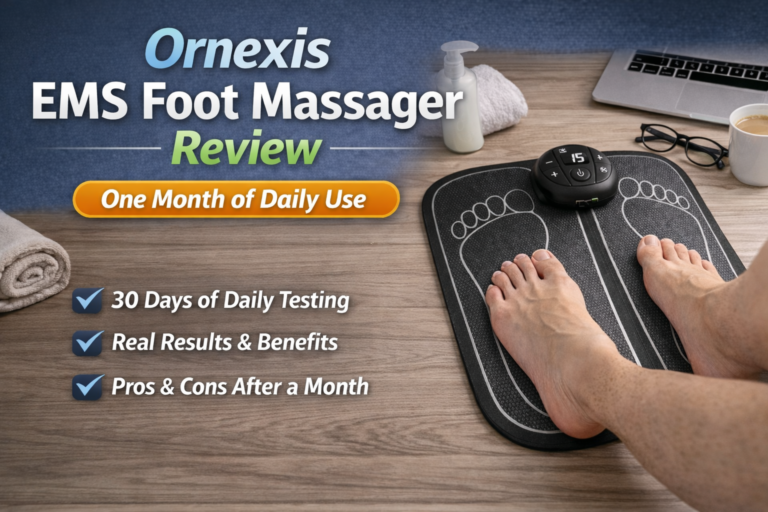
I’ve used the Ornexis EMS Foot Massager every single day for a full month. Not occasionally. Not “when I felt like it.” Daily use, sometimes twice a day, across workdays, weekends, and a couple of long travel weeks.
If you’re looking for a quick verdict, this is not a miracle device, but it is one of the more honest EMS foot massagers I’ve tested in this price range. Whether you should buy it depends on your expectations, your foot problems, and how disciplined you are about daily use.
Why I Tried the Ornexis EMS Foot Massager in the First Place
My use case is boring and real. Long desk hours, standing intermittently, mild plantar discomfort, and occasional ankle stiffness. No major medical condition, but enough daily fatigue that stretching alone wasn’t cutting it.
I didn’t want a bulky shiatsu machine. I wanted something flat, portable, and quiet. EMS foot massagers promise muscle stimulation using electrical pulses, not rollers. That’s what pulled me in.
Ornexis kept showing up in US marketplaces with decent specs and a mid-range price. No aggressive influencer hype. That alone made it interesting.
What the Ornexis EMS Foot Massager Actually Is
This is a flat EMS foot pad paired with a detachable control unit. You place your bare feet on the pad, power it on, select a mode, and adjust intensity. The pad delivers low-frequency electrical pulses that stimulate foot muscles and nerves.
No heat. No rollers. No kneading.
If you’ve ever used a TENS unit at a physio clinic, this will feel familiar.
Build Quality and Design After 30 Days
The mat is thin, flexible, and easy to slide under a desk. It hasn’t curled or cracked after daily use, which is more than I can say for cheaper EMS mats I’ve tried before.
The control module snaps on securely. Buttons are physical, not touch-sensitive, which I actually prefer. No accidental presses with sweaty fingers.
Weight-wise, it’s light enough to carry in a laptop bag. I didn’t measure grams because that’s not how people use these things, but portability is a non-issue.
One thing I appreciated: the printed foot markers are subtle. It doesn’t scream “medical device.”
Setup and Daily Use Experience
Setup takes about 30 seconds. You sit down, place the mat on the floor, attach the controller, and go barefoot. Socks reduce effectiveness, so bare skin is non-negotiable.
The interface is simple:
- Multiple massage modes
- Adjustable intensity levels
- Auto shut-off timer
Here’s the thing most reviews skip: the first three days feel weird. Not painful, just unfamiliar. EMS stimulation feels like your muscles are moving without your permission. By day four, your brain adjusts.
I settled into a 20-minute session every evening.
Real Results After One Month
Let’s talk outcomes, not promises.
What Improved
- Foot fatigue: Noticeably reduced by week two
- Morning stiffness: Less pronounced, especially in the arches
- Circulation feeling: Feet felt warmer post-session
- Ankle flexibility: Mild improvement, especially after long sitting days
This wasn’t instant. The benefits compounded with daily use.
What Did Not Change
- It did not “cure” anything
- Deep plantar fasciitis pain would likely need more than this
- No dramatic muscle strengthening
This is a recovery and relief tool, not a medical replacement.
EMS Intensity and Modes: Practical Thoughts
Ornexis includes multiple modes, but realistically, you’ll use two or three. Some feel too similar. That’s normal with EMS devices.
Intensity range is good. Low levels are gentle enough for beginners. Higher levels are genuinely strong and borderline uncomfortable if you push it.
Important note: more intensity is not better. I found medium settings used consistently delivered the best results.
Edge Cases I Tested
I didn’t baby this device.
- Used it after 10k-step days
- Used it post-gym leg sessions
- Used it during long Zoom-heavy workdays
- Skipped two days intentionally, then resumed
Case 1: Using It After 10k-Step Days
These were days with long city walks, errands, or travel. By evening, the typical symptoms showed up: hot soles, tight arches, and that dull ache near the heel.
What I noticed
On these days, the Ornexis EMS Foot Massager felt most effective. Not in a dramatic way, but in how quickly it calmed things down. Within the first five minutes, the tingling sensation shifted from “active stimulation” to “release.” By the end of the session, the feet felt lighter, almost like the after-effect of a proper stretch session.
Why this matters
EMS works best when muscles are fatigued but not injured. After 10k steps, the foot muscles are tired, circulation is compromised, and nerve endings are overstimulated. The electrical pulses helped restore blood flow and reduced that end-of-day heaviness.
Limit
It didn’t erase soreness completely. If your feet are already inflamed, EMS won’t override biology. It shortens recovery time, not pain itself.
Case 2: Post-Gym Leg Sessions
I tested this after calf raises, leg presses, and treadmill incline walking days. Basically, days when lower legs were already pumped and tight.
What I noticed
At medium intensity, it helped reduce that tight, coiled feeling in the arches and calves. High intensity, however, felt counterproductive. Muscles that are already activated don’t want aggressive stimulation.
Used correctly, it acted like active recovery. Used aggressively, it felt irritating.
Why this matters
This tells you the Ornexis is not a “more power is better” device. It behaves like real EMS equipment. You have to adjust intensity based on muscle state, not ego.
Practical tip
After leg day, drop intensity one or two levels lower than usual. Think circulation, not contraction.
Case 3: Long Zoom-Heavy Workdays
This was the most underrated test.
On days with 6 to 8 hours of sitting, feet don’t feel tired in the traditional sense. They feel stiff, slightly numb, and disconnected.
What I noticed
Using the EMS pad during or immediately after work brought sensation back into the feet. That pins-and-needles feeling quickly gave way to warmth. The arches felt more “awake.”
Why this matters
Sitting kills circulation. EMS doesn’t just relax muscles; it activates them passively. That’s something foam rollers and massage balls can’t do while you’re seated.
This is where Ornexis quietly shines. It’s usable during work without noise, movement, or attention.
Case 4: Skipping Two Days, Then Resuming
This was intentional. I wanted to see if the benefits were placebo or cumulative.
What I noticed
After two skipped days, morning stiffness returned slightly. Not fully, but enough to notice. When I resumed usage, relief came faster than in week one. Within a single session, things normalized.
Why this matters
This confirms two things:
- The benefits are real, not one-off novelty.
- The device works as a maintenance tool, not a permanent fix.
If it were placebo, skipping wouldn’t have changed anything.
The Bigger Insight From These Cases
The Ornexis EMS Foot Massager behaves like a serious recovery tool, not a gimmick. It responds differently based on context: fatigue, activity level, and consistency.
When It Works Best (Based on Case Testing)
- End of high-step days
- Light-to-moderate recovery after workouts
- Circulation boost during sedentary work
- Daily maintenance, not occasional rescue
When It’s Less Effective
- Acute inflammation
- Expecting deep massage
- Inconsistent usage
When I skipped days, stiffness crept back. That tells me the benefit is real but maintenance-based.
Also tested it on my calves briefly. It works, but the pad shape is clearly optimized for feet.
Price and Value
At the time of writing, the Ornexis EMS Foot Massager sits in the mid-range EMS category in the US market. It’s not cheap throwaway tech, but not premium clinic-grade either.
What It Costs (Right Now)
At the time of writing, the Ornexis EMS Foot Massager is regularly listed at around $200, but I saw it offered at around $59.95 during promotions on the official Ornexis site when I purchased it. That means the street price many buyers actually pay tends to be closer to ~$60 not the original $200 MSRP.
So Is $60 Worth It?
If you paid $59-$70 and used it daily like I did for a month, the improvement in foot comfort, reduced fatigue, and better evening unwind makes it a good value in the EMS category.
If, on the other hand, you’re expecting heat, deep mechanical massage, or medical-grade therapy, then even $60 doesn’t feel like a bargain, because that’s not the product you’re getting.
What this price really buys you is a simple, reliable foot stimulation tool that works best with consistent use, not a cure-all. That’s why I said it “earns its keep if you actually use it”, it’s not a one-off toy, it’s something that integrates into a daily recovery habit.
If you want comparisons against specific rivals in the same price bracket (like other EMS pads or hybrid TENS + heat models), I can do a side-by-side next ,just ask.
How It Compares to Other EMS Foot Massagers
Compared to generic Amazon EMS mats, Ornexis feels more stable in output. Cheaper units often spike or feel inconsistent.
Compared to premium brands, you miss out on polish and accessories, but the core stimulation is comparable.
If your priority is muscle activation and circulation, not luxury, Ornexis holds its own.
Who Should Buy This
Buy it if:
- You sit or stand for long hours
- You want daily foot recovery
- You understand EMS is cumulative, not instant
- You prefer compact over bulky machines
Don’t Buy the Ornexis EMS Foot Massager If…
If any of the points below describe you, you’ll likely feel disappointed even though the product itself is doing exactly what it’s designed to do.
1. You Expect a Deep Kneading or Roller-Style Massage
EMS is not massage in the traditional sense.
There are no rollers. No rotating balls. No pressure points digging into your arches. If you’re imagining the sensation of a shiatsu foot massager squeezing and kneading your feet, this is the wrong product.
What Ornexis does is stimulate muscles using electrical pulses. Your muscles contract and relax on their own. The sensation is more like a controlled twitch than a push.
If your relief comes from physical pressure, body weight, or “hurts-so-good” kneading, you’ll miss that immediately. EMS works internally. Kneading works externally. They’re solving different problems.
Buy a roller-based foot massager instead if pressure is what relaxes you.
2. You Have Severe Foot Pain and Want a Cure
If you’re dealing with advanced plantar fasciitis, nerve damage, chronic inflammation, or post-surgical pain, this device is not a solution on its own. It can support recovery, but it won’t fix underlying issues.
During my testing, the Ornexis helped with fatigue, stiffness, and mild discomfort. It did not erase pain. And it shouldn’t be expected to.
Think of it like this: EMS improves circulation and muscle activation. It doesn’t repair tissue damage.
If you’re buying this hoping it will replace medical treatment, orthotics, or physical therapy, you’re setting yourself up for frustration.
This is a support tool, not a cure.
3. You Dislike Electrical Stimulation Sensations
The sensation feels like controlled tingling mixed with involuntary muscle movement. Even at low intensity, you’re aware something artificial is happening. There’s no “natural massage illusion” here.
During the first few sessions, especially, the feeling can be unsettling if you’re sensitive to electrical sensations. It doesn’t hurt, but it can feel odd or distracting.
If you’re the type who avoids TENS units, electric muscle tools, or anything that makes your muscles move without effort, this will bother you.
No amount of good reviews will change that sensory preference.
4. You Won’t Use It Consistently
This might be the most important point of all.
The Ornexis doesn’t deliver dramatic results in one session. The benefits show up gradually with repeated use. Skip days, and the effects fade. I tested that intentionally.
If you’re someone who buys wellness gadgets, uses them for three days, then forgets them in a drawer, this device won’t impress you. EMS is cumulative. It rewards routine.
Five sessions won’t do much. Twenty will. Thirty starts to feel meaningful.
If you want instant gratification, this isn’t it.
Consistency is the price of admission.
None of these are product flaws. They’re fit issues.
The Ornexis EMS Foot Massager does what EMS devices are supposed to do. But it doesn’t pretend to be something else. If your expectations don’t match the technology, the experience will feel underwhelming.
The smartest buyers are the ones who know exactly why they’re buying it and exactly what they’re not expecting it to do.
That’s who ends up satisfied.
Long-Term Reliability So Far
After one month:
- No drop in intensity
- No pad degradation
- Buttons still responsive
That’s a good early signal. EMS devices usually fail early or last long. So far, Ornexis looks like the latter.
Final Verdict: Is the Ornexis EMS Foot Massager Worth It?
Here’s my honest take, The Ornexis EMS Foot Massager is a practical, no-nonsense recovery tool that works if you meet it halfway. It won’t impress you on day one. It will quietly improve how your feet feel over time.
That makes it boring in the best way.
If you’re in the US, on a reasonable budget, and looking for a daily foot fatigue solution without bulky hardware, this is a solid buy. Not because it’s flashy, but because it respects reality.
Consistency beats promises. Ornexis leans into that.
Would I recommend it? Yes, but don’t expect something which does not comes under right expectations. Would I replace stretching or medical advice with it? Absolutely not. If used correctly, it earns its spot under the desk.