
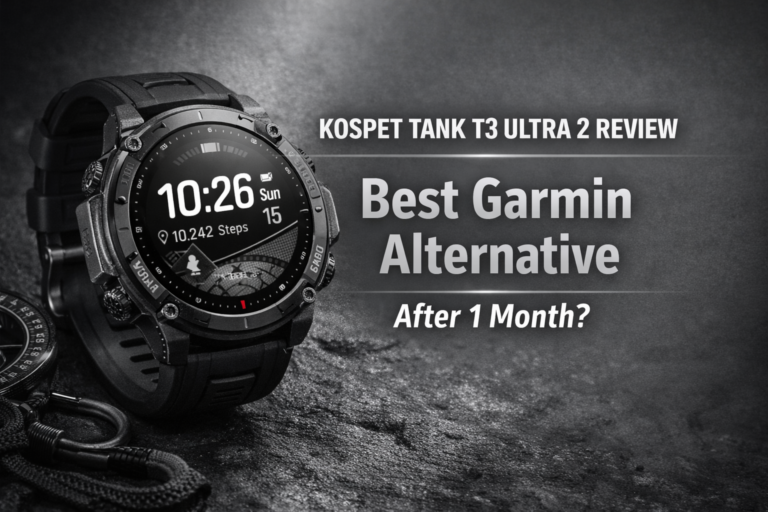
I’ve been wearing the Kospet Tank T3 Ultra 2 every day for a month, showering, commuting, doing long walks and a couple of muddy weekend hikes, and wanted to write a review from that lived experience. The short version, this watch punches well above its price and asks you to rethink what “good enough” means when you’re not desperate for Garmin’s premium ecosystem. But there are trade-offs. Here’s a clear breakdown of what I liked, what annoyed me, and who should actually consider this as a Garmin alternative.
First impressions and build quality
Out of the box the Tank T3 Ultra 2 feels solid. It’s a stainless-steel unibody with four chunky buttons and a 1.43-inch AMOLED that’s bright and surprisingly crisp at 466×466 pixels. The watch looks and feels like a tool rather than a toy — heavy enough to feel durable, but not so bulky it gets in the way of typing or sleeping. Kospet advertises military-grade durability, IP69K + 5ATM water resistance, and a Gorilla glass cover; after a month of knocks and a couple of accidental scrapes, the glass hasn’t picked up any visible marks. Those credentials matter if you’re outdoorsy or clumsy.
Day-to-day experience: battery life, screen and comfort
Battery life is the headline here. I’m getting multiple days of real use with notifications on, heart-rate and SpO₂ tracking enabled, and regular GPS sessions. Kospet claims long runtimes and, in my mixed use, the watch comfortably delivered several days between charges — enough that I stopped worrying about plugging it in every night. The 1000-nit peak brightness makes the screen readable on bright UK mornings and sunny walks, and the AMOLED blacks give the interface a cleaner, premium feel.
Comfort: the strap is functional rather than luxurious, but it’s breathable enough for long wear. I slept with it most nights for sleep tracking and never woke up with irritation.
Sports, GPS and navigation — how close to Garmin?
One reason you might be reading this is to see if the Tank T3 Ultra 2 can replace a Garmin for run, hike or cycle tracking. The watch supports L1+L5 dual-frequency GPS and six global satellite systems (GPS, Galileo, GLONASS, BeiDou, QZSS, NAVIC). In practice that translated to surprisingly reliable routes: my runs and hikes matched smartphone GPS tracks closely, and the “route back” feature will get you back along the line you came on if you stray. That said, there are important limits — there’s no true offline mapping experience, turn-by-turn map navigation or the deep third-party training ecosystem Garmin offers. For accurate route lines and reliable distance tracking on trails or urban runs the tank performed admirably; for advanced navigation or mapping you’ll miss Garmin’s maps and platform.
Health tracking and sensors
Kospet packs the usual sensors: heart rate, SpO₂, barometer, compass, and accelerometers for activity detection. Daily heart-rate and SpO₂ tracking felt consistent for general trends — resting heart rate, sleep trends and workout spikes were usable and believable. Don’t expect clinical accuracy: if you need hospital-grade readings, this is not the right device. But for monitoring fitness progress and spotting trends over weeks, it’s perfectly serviceable. Sleep tracking captured basic sleep stages and sleep time and matched how I felt on most mornings.
Software: Kospet Fit app and on-watch UI
The Kospet Fit app is lightweight and does the job: syncs workouts, shows daily health summaries, and lets you tweak watch faces and notifications. The interface is not as polished as Garmin Connect. Expect a learning curve for some of the deeper settings; route uploads, export options and training plans aren’t as feature-rich as Garmin’s platform. On the watch, the UI is straightforward and responsive, with reliable Bluetooth calling and on-watch media control when paired to a phone. If you want a deep training platform with advanced metrics, the software gap is real — but for everyday fitness tracking and route recording it’s enough.
Everyday features that stood out
- Bluetooth calling and speaker: useful for quick hands-free calls on short walks. Quality is fine for calls but don’t expect stellar mic performance in windy conditions.
- 170+ sports modes: overkill for many, but it means the watch has presets for practically any activity you want to record.
- Ruggedness + style: the stainless body looks premium compared to many budget rivals; if you want something that visually reads as “tool” rather than toy, this is a win.
What didn’t impress
- No offline maps or fully featured navigation: Garmin still leads here. If you rely on offline topographic maps, route guidance or downloadable map tiles, the Tank T3 Ultra 2 won’t replace a Garmin with mapping.
- App polish and ecosystem: the app works but isn’t as sophisticated as Garmin Connect, Suunto or Polar’s ecosystems. If you’re invested in platforms for structured training plans, third-party app support or deep analytics, you’ll feel the absence.
- Occasional UI quirks: a couple of menu animations or settings weren’t immediately obvious. These are fixable with software updates, but they’re worth mentioning for users who like ultra-smooth polish.
Value: the big question — is it worth replacing a Garmin?
This is where context matters. The Tank T3 Ultra 2 targets users who want strong hardware, reliable multi-band GPS, long battery life and rugged build without a Garmin price tag. If you’re a casual to intermediate runner, cyclist or outdoor enthusiast who primarily needs accurate tracking, route recording and robust construction, the Tank T3 Ultra 2 represents outstanding value. Several reviews and product pages flag it as a cost-effective Garmin alternative for people who don’t need advanced mapping or training tools.
If, however, you’re a serious athlete who relies on structured training plans, advanced performance metrics, downloadable maps and a mature third-party app ecosystem, Garmin’s ecosystem still wins. Garmin watches are more expensive for a reason: they offer depth across hardware, software and services that budget-minded brands can’t fully match.
buyer considerations
For buyers, the Tank T3 Ultra 2 is best framed as a value alternative. You’ll save a significant amount compared to mid-range Garmin models, and for everyday use and most trail needs you won’t miss much. Warranty and local support vary by retailer, so buy from a reputable seller or the official Kospet UK store where possible. Also check compatibility with your phone, Kospet supports Android and iOS, but some features (like deeper app integrations) can behave differently between platforms.
Who should buy the Kospet Tank T3 Ultra 2?
Buy it if:
- You want a rugged watch with reliable multi-band GPS and long battery life without paying Garmin prices.
- You’re an outdoor hobbyist who values durability, route recording and clear on-screen data.
- You want good health tracking and notifications, but you don’t need advanced mapping or coaching ecosystems.
Look elsewhere if:
- You need offline maps, turn-by-turn navigation or advanced training analytics.
- You depend on a mature third-party ecosystem or very accurate, lab-grade physiological metrics.
Final verdict
After a month of daily use, the Kospet Tank T3 Ultra 2 has earned a clear spot in my rotation. It’s a rugged, well-built watch with modern GPS, long battery life and a screen that looks classier than its price suggests. For many UK users, weekend warriors, commuters, casual runners and outdoor hobbyists, it is a very compelling Garmin alternative. It won’t replace Garmin for professionals or serious athletes who need maps and advanced training features, but for most people who want strong performance and value, it’s an easy recommendation.
If you’re debating between saving money and getting a high-end Garmin, ask yourself: do I need offline maps and a detailed training ecosystem? If the answer is no, the Tank T3 Ultra 2 is worth a close look. If you want a watch you can knock about, rely on for decent GPS tracks and forget to charge for a few days, this one is a winner.