

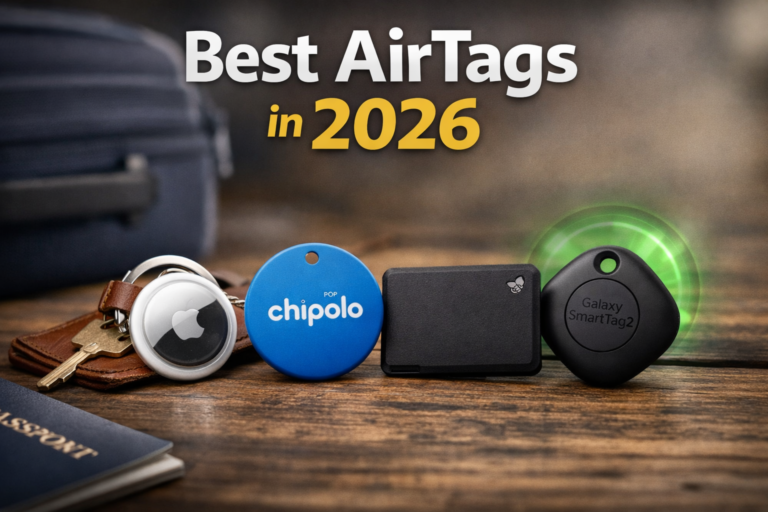
People call every tracker an AirTag now. Fair enough. What you really want is a tiny tag that helps you find keys, a backpack, a wallet, or even luggage, without turning your day into a detective show.
I’ve tested the five most practical picks you can actually live with in 2026, the way most of us use them: clipped to keys, dropped into a bag, shoved into a wallet slot, and forgotten until that one stressful moment. This is my personal take on the Best Airtags in 2026 (yes, including the real Apple AirTag), and why each one made my Top 5 Airtags in 2026 list.
Before we jump in, here’s the thing: a tracker is only as good as the network behind it.
- Apple Find My uses nearby iPhones/iPads/Macs to help locate your tag.
- Google’s Find Hub / Find My Device network uses nearby Android phones.
- Samsung SmartThings Find works best if you’re in the Samsung Galaxy ecosystem.
Pick the wrong ecosystem and even the “best” tracker feels useless.
How I judged these trackers (the stuff that matters after week one)
After the initial fun of making it beep, you start caring about boring, real-life things:
- Finding accuracy: Does it guide you to the exact spot or just the general area?
- Sound: Loud enough to hear under a sofa cushion or inside luggage?
- Battery: Replaceable vs rechargeable, and how often you’ll think about it.
- Durability: Water resistance matters more than people admit.
- Extras you’ll actually use: Left-behind alerts, sharing with family, safety features.
Now, the Top 5 Airtags in 2026.
1) Apple AirTag (best for iPhone users, still the smoothest)
If you’re on iPhone, the AirTag remains the easiest “just works” option. Setup takes seconds, and the Find My app experience is still the cleanest. The big win is Precision Finding using Apple’s U1 chip (Ultra Wideband) on supported iPhones, which gives you direction + distance and basically walks you to your keys.
What it’s like after a month
This is the tracker I thought about the least, which is a compliment. I used it on my keys and one in my backpack. The “left behind” reminders (via Find My) saved me twice: once at a café, once at the office.
Pros
- Precision Finding is genuinely helpful (not just a gimmick).
- Uses a replaceable CR2032 battery (simple, available).
- Solid water resistance rating (IP67).
Cons
- The tag itself doesn’t have a built-in keyring hole, so you’ll likely buy an accessory.
- Best features lean heavily Apple-only (as expected).
Who should buy
Anyone with an iPhone who wants the most frictionless experience. If your goal is “find my keys fast” and you’re in the Apple world, this is still the benchmark for the Best Airtags in 2026.
Remember: AirTags use end-to-end encrypted relay through Apple’s network, so even Apple can’t see locations
2) Chipolo POP (best if you might switch between iPhone and Android)
Chipolo POP is one of the most sensible “modern” trackers because it supports Apple Find My or Google’s network (you choose one during setup). The big deal is flexibility: if you change phones later, you’re not stuck with a tracker that belongs to your old ecosystem.
What it’s like after a month
I like POP for bags and everyday items where you mainly need a loud beep and decent map location. The alarm is loud (on paper it’s around 120 dB), and the range improvements are noticeable in normal use.
Pros
- Works with Apple or Google networks (choose one).
- Loud, simple, colourful, and easy to attach.
- Uses a replaceable battery with about a year claimed life.
Cons
- It’s not trying to beat AirTag on Precision Finding for iPhone users.
- Water resistance is decent, but not the top tier compared to some newer tags.
Who should buy
If you’re buying trackers for family where some use iPhone and some use Android, or you just don’t want to be locked in. For most people, this is quietly one of the Top 5 Airtags in 2026 because it avoids regret.
3) Pebblebee Card 5 (best wallet-style tracker, thin and rechargeable)
Wallet trackers are usually annoying because they’re either too thick or they die at the worst time. Pebblebee’s Card 5 leans into what a wallet tracker should be: thin, rechargeable, and built for daily carry.
It supports Apple Find My or Google’s Find Hub, again with a one-network-at-setup approach, and it’s designed specifically for wallets, passport holders, and slim pockets.
What it’s like after a month
This is the one I’d keep in a travel wallet. It stays out of the way, and the recharge routine is predictable. Battery claims are strong (reported up to 18 months), which is exactly what you want in something you don’t want to “maintain.”
Pros
- Wallet-friendly design, very slim.
- Rechargeable, no coin-cell battery hunting.
- Works with Apple or Google networks (choose one).
Cons
- If you want a keychain tracker, Pebblebee’s Clip is a better physical shape.
- Choosing the network at setup means you should decide your ecosystem first.
Who should buy
If you lose your wallet more than your keys, or you travel a lot. For many people in 2026, a good wallet tracker is more useful than a key tracker, which is why this belongs in the Best Airtags in 2026 conversation.
4) Samsung Galaxy SmartTag2 (best for Samsung users, serious battery life)
If you’re in the Samsung Galaxy ecosystem, SmartTag2 is the “native” answer. It’s built to work with Samsung’s finding experience and has some standout battery claims (up to 500 days, and Samsung has also talked about longer life in Power Saving Mode).
It also carries an IP67 rating and supports features like Search Nearby / Compass View for more guided finding within Samsung’s system.
What it’s like after a month
SmartTag2 feels like the Android equivalent of “made for the platform,” but specifically for Samsung people. The biggest comfort is battery: you stop worrying about it. If your household is mostly Galaxy phones, sharing and daily use feels natural.
Pros
- Strong battery life claims (the main selling point).
- IP67 rating.
- Best experience if you’re already on Samsung services.
Cons
- If you’re not a Samsung user, don’t buy this. You’ll never get the full value.
- Less appealing for mixed Android households compared to Google-network trackers.
Who should buy
Samsung users who want a reliable tracker for keys, bags, and even pets’ collars (with the right holder). In a Samsung-heavy environment, it’s easily one of the Top 5 Airtags in 2026.
5) Motorola Moto Tag 2 (best “AirTag-style” option for Android, UWB + huge battery)
This is the one I’ve been waiting for on the Android side: a tag that’s clearly aiming for that AirTag-style experience, including UWB for more precise location and a very strong battery life claim of 500+ days, plus IP68 resistance.
It’s built for Google’s network (Find Hub / Find My Device), and Motorola also includes a button that can help you ping your phone or act as a remote camera shutter.
What it’s like after a month
For Android users, this is the most “premium tag” vibe right now: sturdy, long-lasting, and more future-facing. If you’ve ever felt Android trackers were either basic or inconsistent, Moto Tag 2 is Motorola saying: no, we can do this properly.
Pros
- UWB support + Google network focus.
- 500+ days battery claim with CR2032 replacement.
- IP68 durability is excellent.
Cons
- Availability and pricing can vary by region (especially outside North America).
- Like most tags, the “magic” depends on how many phones are around you.
Who should buy
Android users who want the closest thing to an AirTag-style experience in 2026. If you’re searching for the Best Airtags in 2026 but you’re not on iPhone, this is the one to watch.
Price Comparison
If you’re buying in the US, the price story in 2026 is basically this: Apple is no longer the “expensive” option if you buy multipacks, but Android trackers have some sneaky extra value depending on what you’re tagging.
Here’s how the Top 5 Airtags in 2026 compare on price in the USA, in a way that actually helps you decide.
Apple AirTag (iPhone)
Apple’s own pricing: $29 for 1, $99 for a 4-pack (so $24.75 each).
Real-world deal pricing: 4-packs regularly dip to under ~$65 at big retailers during promo windows.
What this means when choosing
- If you need 3–4 trackers, AirTag becomes the best value fast (especially on sale).
- If you only need one, $29 is fine, but don’t forget you’ll likely spend extra on a keyring/holder.
Chipolo POP (Apple Find My or Google Find Hub)
Direct pricing: $29 each, and $89 for a 4-pack (about $22.25 each).
What this means when choosing
- This is the best “buy a bunch” value when you don’t want to commit to Apple-only or Samsung-only.
- It’s also one of the few where the design is already keyring-friendly, so fewer accessory purchases.
Pebblebee Card 5 (wallet-style, Apple or Google network)
Direct pricing: $34.99.
What this means when choosing
- Cost per tracker is higher than POP/AirTag multipacks, but it’s a different product category: you’re paying for a slim wallet form factor and rechargeability.
- If you were going to buy a wallet holder + tag anyway, the Card 5 can actually end up feeling “cheaper” in the long run because it’s purpose-built.
Samsung Galaxy SmartTag2 (Samsung Galaxy users)
Samsung US pricing: $20.99. (Discounted)
$29.99 MSRP, often discounted to around $20–22
What this means when choosing
- Cheapest “serious” option here if you’re on Samsung.
- If you’re not on Samsung, skip it. The lower price won’t matter if the experience is half-baked on your phone.
Motorola Moto Tag / Moto Tag 2 (Android, Google network)( this one was pre-release unit)
Moto Tag 4-pack on Motorola US site: $99.99.
Moto Tag 2 pricing (latest reporting): announced at €39, with US availability mentioned as “coming months” (US $ pricing not final at this stage while testing).
What this means when choosing
- Motorola is pushing “premium Android tag” pricing. If you want UWB-style precision on Android, you often pay for it.
- If you’re price-sensitive, you buy these as a pack; if you’re feature-sensitive (UWB + durability), you buy even if it costs more.
The buying logic (so you don’t overpay)
If you’re deciding purely on value per tag:
- Cheapest per unit in a 4-pack: Chipolo POP (at $89).
- Best iPhone value when on sale: AirTag 4-pack deals can beat everyone.
- Cheapest single tag (ecosystem-dependent): SmartTag2 at $20.99, but only if you’re a Samsung user.
If you’re deciding based on “total cost to actually use it”:
- AirTag often needs a holder (extra spend).
- Chipolo POP is already attachable.
- Pebblebee Card 5 avoids wallet accessories entirely because it’s the wallet form factor.
If you tell me your phone model (iPhone vs Samsung vs other Android) and how many tags you want (1, 2, 4, or more), I’ll recommend the cheapest “no regrets” purchase path for the US, including whether to buy singles or a pack
Quick picks: which one should you buy?
If you want the simplest decision:
- iPhone user: Apple AirTag
- Android (any brand) and want modern network support: Moto Tag 2
- Samsung Galaxy user: SmartTag2
- Wallet tracker: Pebblebee Card 5
- Mixed family or future-proofing: Chipolo POP
Final thoughts: what “Best Airtags in 2026” really means
In 2026, the tracker market is less about who makes the smallest circle and more about which network you live in every day. The Top 5 Airtags in 2026 above cover the real-world situations I see constantly: iPhone users, Android users who want something better than basic, Samsung households, wallet people, and families with mixed phones.
If you tell me which phone you use (iPhone, Samsung, or other Android) and what you’re tracking (keys, wallet, luggage, bike), I’ll narrow this down to the single best pick for you and suggest the right accessory too.